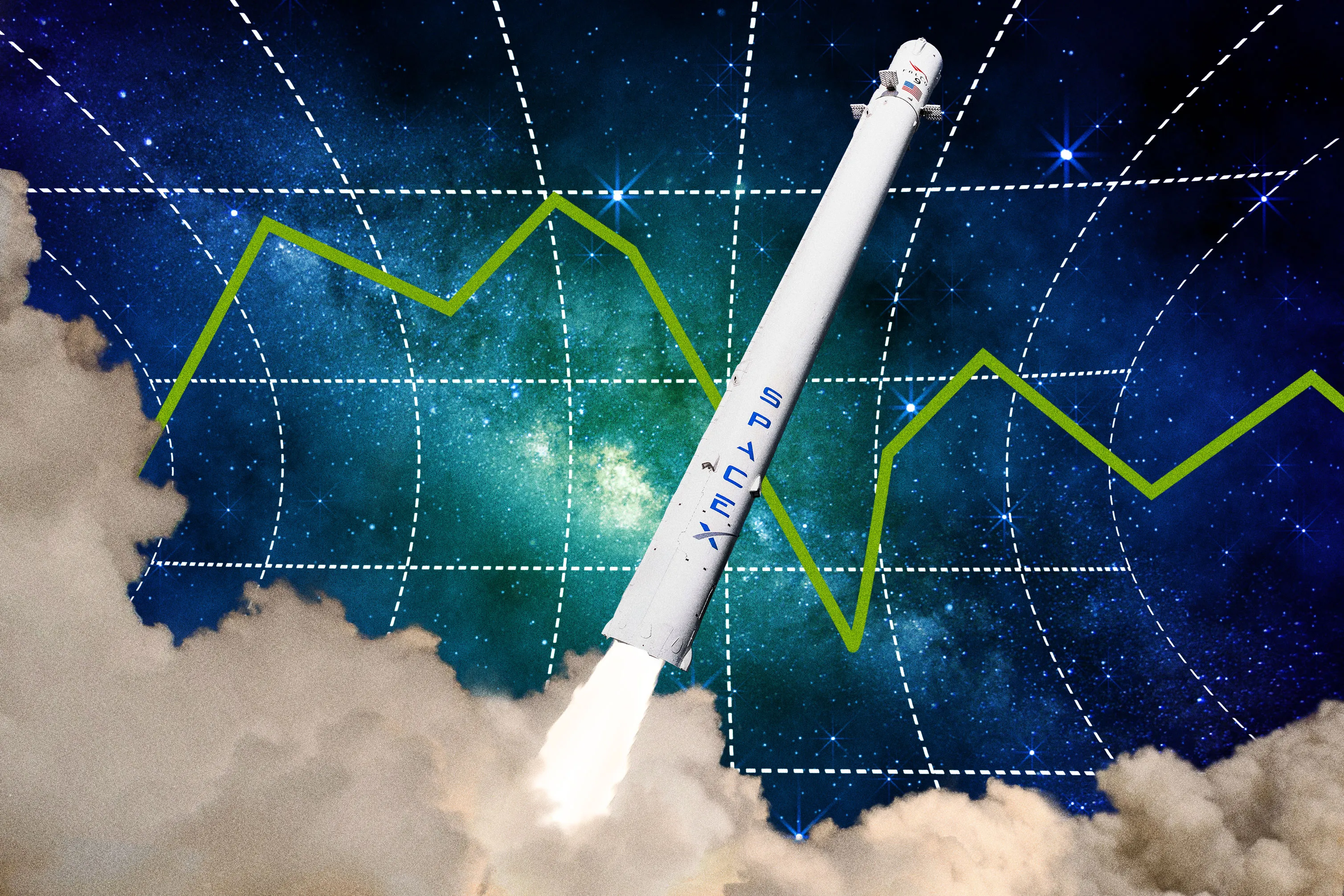
After years of anticipation, Elon Musk has secretly filed an initial public offering (IPO) for SpaceX with the US Securities and Exchange Commission.
The move positions the aerospace and artificial intelligence company, founded by Musk in 2002, to go public as soon as June. It also sets the stage for the world’s richest man to become the first CEO to lead two publicly traded companies valued at more than $1 trillion.
Access to IPOs has traditionally been reserved for institutional investors (such as asset management firms, investment banks and hedge funds) and accredited investors (such as individuals with a net worth of more than $1 million, excluding their primary residence, or an annual income of more than $200,000). But there’s a way for everyday investors to get exposure to SpaceX before it goes public — at a relatively high price.
Here’s what you need to know.
SpaceX’s IPO could be the largest in history
Combining rocket launch services, the Starlink satellite business segment and – following the recent merger with xAI – major language models, SpaceX wants to raise between $50 billion and $75 billion through its public offering. That would make the company’s IPO the largest in history, topping the $25.6 billion raised by Saudi Aramco, the owner and operator of the world’s largest oil and gas network, when it debuted in 2019.
Additionally, by targeting an IPO value of $2 trillion, SpaceX will become the sixth largest publicly traded company, trailing only Magnificent Seven members Nvidia, Apple, Alphabet, Microsoft and Amazon.
For context, the market capitalization of Musk-led Tesla is currently $1.29 trillion.
Part of the appeal to investors is the company’s recurring revenue model, which relies on Starlink’s high-speed, low-latency space-based internet subscriptions. More than 10,000 Starlink satellites are currently in orbit serving more than 10 million customers worldwide.
SpaceX is also a top government contractor, having received an estimated $22 billion in government contracts with organizations including NASA and the US Department of Defense.
The company’s recent merger with xAI puts the $250 billion AI company in SpaceX. As a subsidiary, xAI launches an array of revenue streams including Colossus, the world’s most powerful AI supercomputer. As part of the merger, SpaceX is now working on the development of space-based data centers, using solar-powered satellites to scale the company’s AI supercomputer.
How to invest in SpaceX
While SpaceX’s official listing date has yet to be announced, retail investors can gain access ahead of its IPO through a niche investment vehicle. However, it comes with significant drawbacks that not everyone can be comfortable with.
ARK Venture Fund, or ARKVX, is actively managed by Ark Invest, an investment management firm led by founder and CEO Cathie Wood (known for investing in disruptive technology companies). The fund aims to provide retail investors with access to venture capital investments, including SpaceX.
However, unlike the direct exchange-traded funds that have grown in popularity, the ARK Venture Fund is a closed-end fund – a type of investment company registered with the SEC that is not traded on the exchange, which often invests in other assets such as private equity and can present legal challenges. Shareholders of short-term funds do not have the ability to sell freely until periodic repurchase windows open.
In the case of ARK Venture Fund, those opportunities come every quarter. But a disclosure on Ark’s official website warns prospective investors and current shareholders of that illegality risk, saying “You should not expect to be able to sell your Shares without the Fund’s repurchase policy, regardless of how the Fund operates… Shares during the quarterly repurchase period.”
This disclosure also states that “investment in the Fund’s shares is not suitable for investors who need liquidity, except for the liquidity provided by the Fund’s repurchase policy.”
Palash S. Islam, CEO of Singer Financial Group, says this is not necessarily a red flag. But he warns investors who want to jump in now.
“It’s too late now. They missed the boat,” he wrote in an email to Money.
Islam also points out that the “retail sorapper” – using a fund to give daily investors access to pre-IPO companies – removes visibility and flexibility. He adds that investing in the ARK Venture Fund just to gain exposure to SpaceX ahead of its IPO is hard to justify, noting that “Ship will likely use momentum and excitement to drive higher capital into the fund.”
More money coming into the fund does not directly translate into higher prices, but it does translate into more income for the fund managers. (Ark Invest did not immediately respond to Mali’s request for comment on this and other details.)
Another consideration is the fund’s annual fee, which currently stands at 3.49% and is “much higher than conventional management,” Islam said.
For context, the average expense ratio of a fully managed ETF falls between 0.5% and 0.75%. Even after the 0.59% expense return and waiver offered by Ark Invest, its Venture Fund’s average expense ratio is still 2.90% — 364% above the average for actively managed ETFs.
For investors who can look beyond those conditions, shares are available through platforms like SoFi and Titan with a minimum investment of $500, according to the fund’s prospectus. Beyond SpaceX – ARK Venture Fund’s top holding, which currently accounts for 17.02% of the total portfolio – also provides exposure to ChatGPT creators OpenAI, Anthropic and other tech startups that could eventually see their own IPOs.
“We tend to stay away from deals like this,” Islam said. “But for other clients, if they want [pre-IPO] access, this may be the only way. I hope they went in years ago and are not in a rush to come back today. “

More from Mali:
Is This 2008 Again? Fears of Financial Crash Growing Among Investors
Private Equity, Crypto and Other Risky Assets Come to Your 401(k). Here’s What You Should Know
You Can’t Buy Stock at Launch After DiscussionGPT. But You’re Probably Invested In It Anyway