Every day, your organization generates a mountain of words. Support tickets, contracts, clinical notes, customer reviews, emails, call scripts. About 80% of all business data exists as unstructured text like this – and until recently, almost none of it could be analyzed at scale. It just sat there.
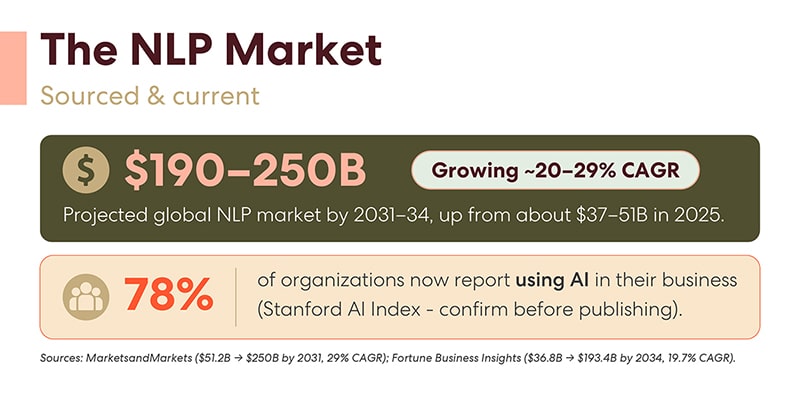
Natural Language Processing changed that. And in 2026, with large language models now doing the hard work, NLP has moved from a research field to the engine behind every AI product you touch. The market is showing: analysts project NLP will grow from $37–51B in 2025 to $190–250B in the early 2030s, and 78% of organizations already report using AI in their business.
So what exactly is NLP today, how does it really work, and where is it going? Let’s break it down.
First, Let’s Clear Up the Biggest Confusion: NLP vs. LLM
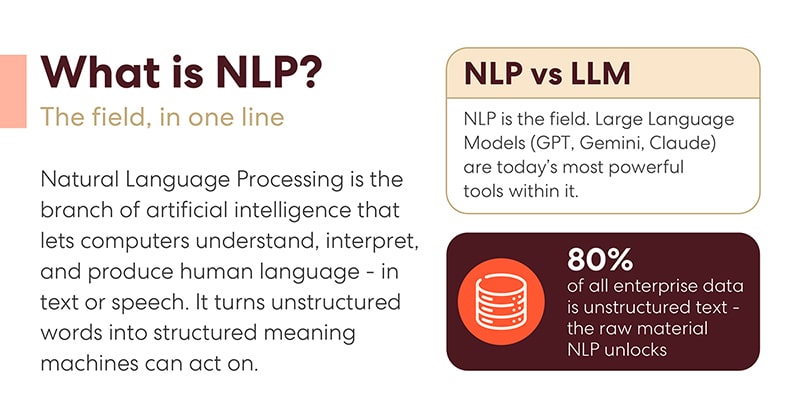
Ask ten people what is the difference between NLP and LLM, and you will get ten wavy answers. Here’s the clean version: NLP is a field – the entire branch of AI that deals with machine understanding, interpretation, and human language production. Major Language Models like GPT, Gemini, and Claude are tools in that field. They are the most powerful tools NLP has ever produced, which is why the two terms are blurred together.
Think of it like medicine and MRI machines. MRI has changed medicine, but no one says medicine is something An MRI. The same relationship. Every LLM is an NLP program; NLP is much bigger than any one model.
This distinction is practically important, too. A lot of business problems – submitting a support ticket, tagging a contract clause, tagging sentiment in reviews – don’t require a borderline LLM. They need the right NLP method, which is often smaller, cheaper, and faster.
How Modern NLP Works
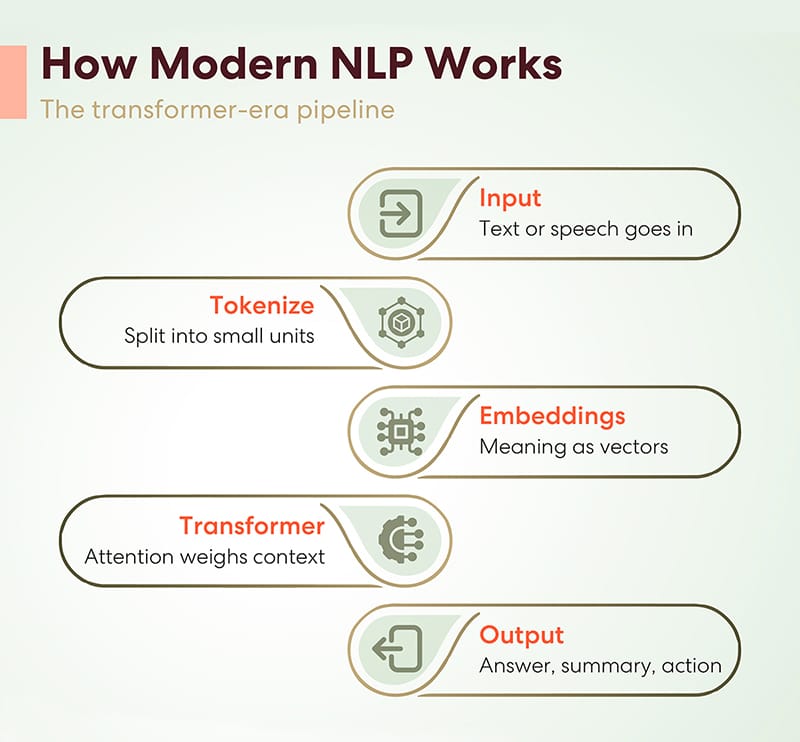
Strip away the hype and almost every modern NLP program works along the same five-step line.
Enter text or speech. The program tokens it, in turn, breaks down the language into smaller units that the model can handle. Those tokens have to embed — vectors of numbers that comprise the mean, so that “doctor” and “physician” are close together in the mathematical space. Then came the part that changed everything: i a transformerwhose attention mechanism weighs every token against every other token to determine what is really important in context. That’s how the model knows that “the bank approved the loan,” you’re not talking about the river. Finally, the model produces i output — answer, summary, translation, action.
That’s all. Input → token → embed → move → output. Transformer architecture, introduced less than a decade ago, now sits at the base of nearly every AI language program in production. When people talk about the “LLM era,” they are really talking about the scale transformer era.
What NLP Can Do – And How The Definition Of The Job Has Changed
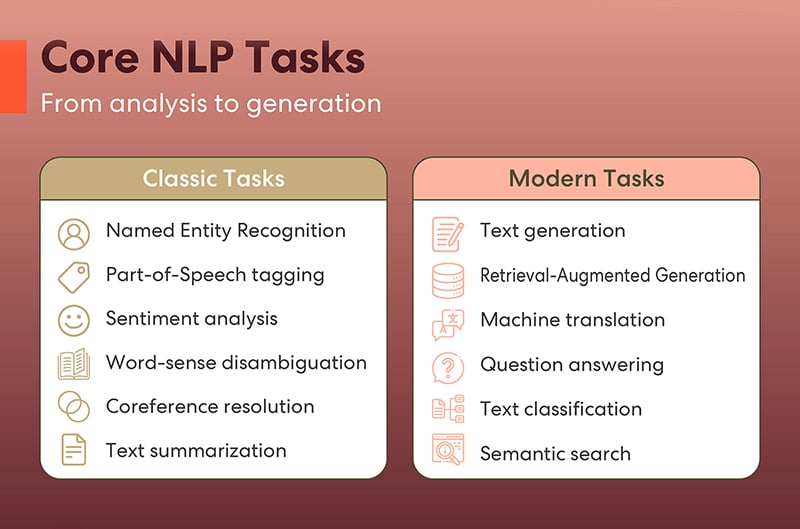
A list of NLP activities tells the story of the field’s evolution.
The old jobs were about analysis: pulling words, companies, and dates out of text (named business recognition), marking parts of speech, finding emotions, saying which meaning of a word applies to the context (word sense disambiguation), finding out what “it” means (reference resolution), and summarizing long documents into short sentences. These are still workhorses – quietly powering compliance systems, search engines, and document pipelines everywhere.
But the modern era added a generation in assembly. Today’s programs don’t just learn the language, they generate it: writing text, answering questions, translating between languages, classifying texts by level, enabling semantic search that is similar to purpose rather than keywords, and performing an improved generation of retrieval — more on that below, because it finds its place.
The shift from analysis to generation is one of the biggest changes in the history of NLP. Machines went from compiling articles to writing them.
Seven Ideas Driving NLP Right Now
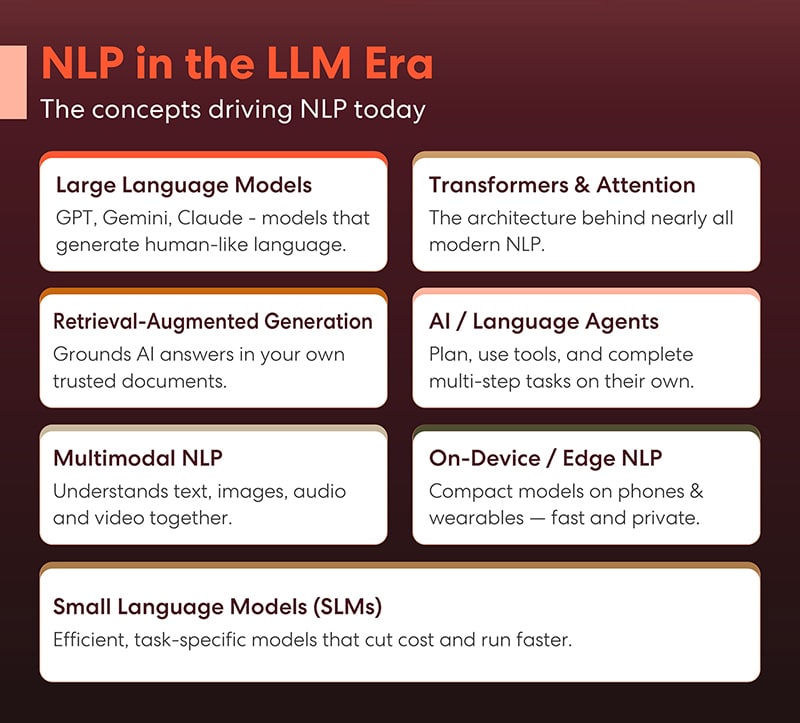
Seven concepts define the current landscape – and knowing them will help you differentiate any AI marketer in 2026.
Major Language Models (LLMs) they are the subject action: GPT, Gemini, and Claude produce human-like language with a fluency that seemed impossible a few years ago. It’s the reason NLP is moving from the back office to the boardroom conversation.
Transformers and attention there are machines underneath. Almost every modern NLP system – from borderline LLMs to auto-complete on your phone – is built on this diagram, allowing models to measure the context of all text at once.
Retrieval-Augmented Generation (RAG) is a business favorite of the seven, because it supports AI responses to your trusted documents. Instead of trusting the model’s memory, you point it to your proven knowledge base – and ideas that don’t go down too well.
AI and language agents take models from answering questions to completing a task: planning steps, calling tools, and performing multi-step tasks with minimal supervision. If 2024 was the year of chatbots, 2026 is shaping up to be the year of agents.
Multimodal NLP it eliminates the boundary between text and everything else. Modern systems process text, images, audio, and video together — reading a chart, listening to a call, and summarizing both in one pass.
On the device / on the edge of NLP is pushing integrated models into phones and wearables, where the thinking happens locally. The reward is speed and privacy: your data never leaves the device.
Small Language Models (SLMs) they’re the opposite of “bigger is better”: functional, task-specific models that cost a fraction of a borderline LLM and run fast – often the smart choice for a well-defined task.
Where NLP Finds Its Maintenance
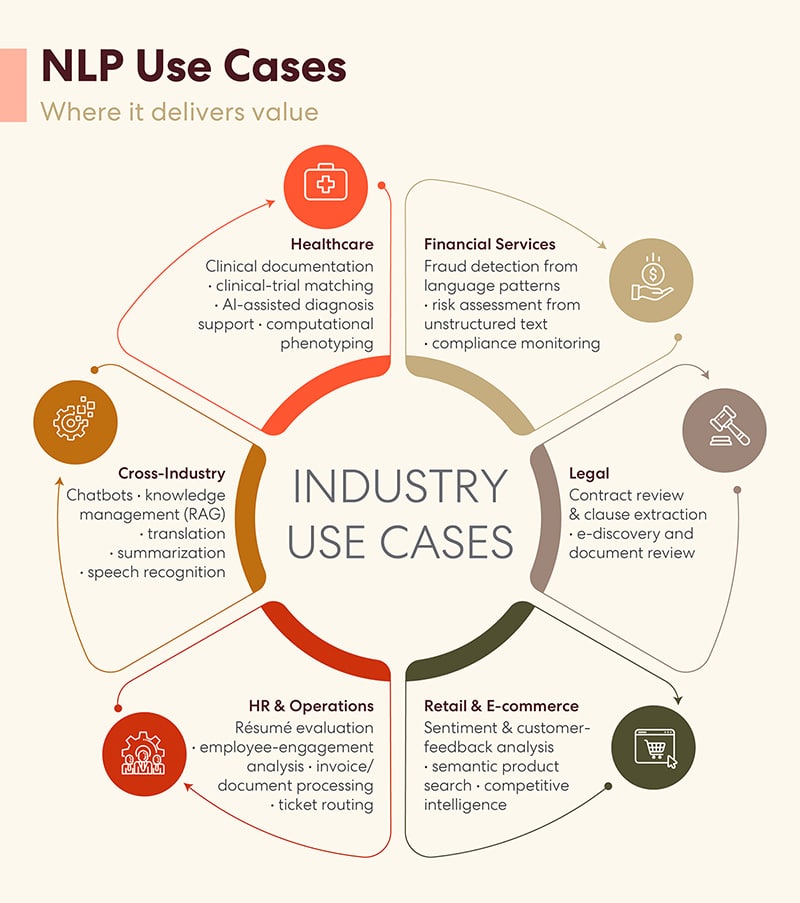
Use cases are no longer predictable – they are line items in budgets across industries.
In health careNLP writes clinical notes (giving doctors back hours a week), matches patients to clinical trials, and backs up diagnoses with mining notes that no one could read on a scale. In financial servicesit detects fraud through language patterns and monitors communications for compliance — a task that required armies of reviewers. Legal teams use it for contract review, clause release, and e-discovery, compressing weeks of document review into days. Sellers my client’s emotional response and the power of semantic search that understands intent, not just keywords. HR and operations teams use it for resume testing, engagement analysis, invoice processing, and ticket routing.
And cutting across the industry: chatbots, information management with RAG, translation, summarization, and speech recognition. A common string remains the same — previously unusable text becomes actionable data.
Honest Image: The Benefits and What’s Still Going Wrong
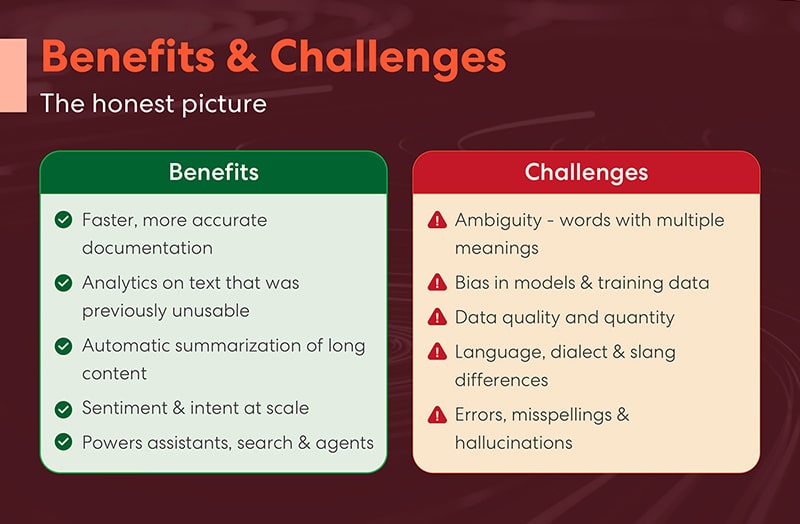
The benefit of all this is concrete. Documents are written faster and more accurately. Previously unusable text becomes analyzable data. Longer content is shorter. Sentiment and intent can be learned at scale across millions of interactions. And the entire stack powers the assistants, search engines, and ambassadors your teams already rely on.
But it would be dishonest to end the tour there, because NLP in 2026 still has real problems.
The language is vague — words have multiple meanings, and models still stumble over context that no one can grasp. Models are inherited bias from their training data, which can silently bias hiring tools, credit decisions, and content ratings. Data quality it remains an undesirable bottleneck: only good models learn from it, and high-quality, well-annotated training data are scarce and expensive. Dialects, slang, and less commonly used languages tend to perform worse than standard English. And misperceptions – confidence, slippage, wrong exits – are always a failure mode that keeps business deployments on their toes.
None of these are reasons to stay out. Reasons to use thoughtfully: models based on verified data, check and move on yours language and yours users, and keep people informed when mistakes are costly. Notably, many of these challenges go back to the same root – the data models are trained and tested on – which is why data quality has become a competitive differentiator, not a checkbox.
Next: Five Trends to Watch Through 2026
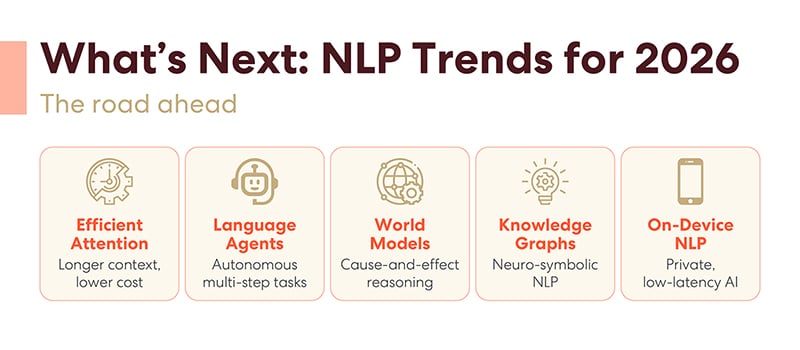
Looking ahead, five developments are set to define the next stage of the field. Active attention methods increase context windows while reducing costs, allowing models to be considered across codebases or case files simultaneously. Language ambassadors they transition from demos to production, automating multi-step workflows. World models it aims to give AI a real sense of cause-and-effect rather than pattern matching. Knowledge graphs they combine neural methods – neuro-symbolic NLP – to make the results of the model more realistic and readable. Again in the NLP device it keeps shrinking the skillful models until a private, low-latency AI enters your pocket.
The pattern in all five: less power, more precision. Cheaper, faster, more focused, closer to the user.
The Bottom Line
NLP in 2026 is no longer an emerging technology – it is an infrastructure, incredible and as important as a database. Leading organizations are not questioning or using NLP; they are the ones asking what tasks to do first, how to lay down models on their data, and how to make sure the underlying training data is all worth learning from.