Creatio is betting that the future of business AI will not belong to autonomous agents. It expects organizations to integrate people, traditional workflows, and AI agents within a single platform. That’s the strategy behind Creatio 10x, the company’s latest CRM and workflow release, which combines AI agent creation, governance, and CRM into a single AI platform.
“The organizations of the future will consist of people, AI, and processes,” said John Arnold, head of AI CRM product sales at Creatio. “Somewhere in between, you’ve got this perfect mix of people, traditional workflows… AI assistants and autonomous agents. Every organization is different.”
That philosophy reflects a broader shift in enterprise software. Many vendors now offer AI agents. The competition turns to a different question: how organizations manage those agents, integrate them into existing business processes, and avoid creating another disconnected layer of technology.
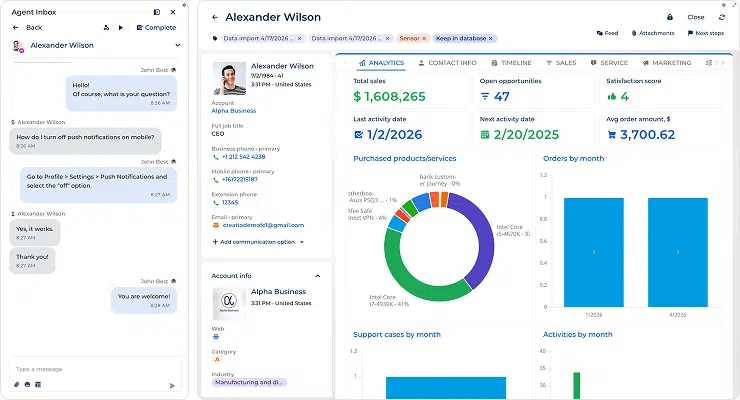
Creatio’s answer is to make CRM the foundation where all that happens. Instead of positioning AI as a separate application, the company wants its organizations to deploy, manage, and monitor agents alongside the customer data and workflows they already use.
AI is becoming part of everyday work
Creatio 10x introduces two complementary products that target different segments of the organization.
AI Twin allows workers to create AI agents through a conversational interface without writing code. AI Studio gives IT and operations teams the tools to build, manage, and manage enterprise-class advanced agents. Together, they support everything from simple task automation to fully managed agent workflows.
The release also extends AI to all of the company’s CRM products. Marketing teams can use agents to create audience segments, create campaign assets, and plan campaigns. Sales teams gain AI-powered forecasting and sales tools, while customer service teams gain expanded AI-powered omni-channel conversational capabilities.
The bigger point is not individual characteristics. That Creatio sees AI as another layer within existing workflows rather than removing that workflow entirely.
Arnold said that deterministic business processes are always the best choice for many repetitive tasks. AI agents become useful when organizations need to think, synthesize, or navigate situations that are more complex than normal work operations.
Walking beyond Frankenstack
That same thinking extends to business software itself.
Arnold believes that organizations are reaching the limit of managing collections of specialized applications connected through custom integrations and solutions.
“We’re starting to see that, to withdraw those point solutions,” he said. Instead of buying another operating system, organizations are increasingly asking whether they can build the capabilities they need on top of the platform they already use.
He described many business areas as “Frankenstacks” composed of tribal knowledge and manual workarounds. Rather than expanding those stacks, Creatio’s strategy is to make CRM an integrable platform where organizations can build the workflow and AI capabilities they need without adding another point solution.
That reflects a broader trend across enterprise software. As AI capabilities become more common, vendors are increasingly competing on platform integrations as much as on AI itself.
10X your SEO with Semrush for Enterprise.
The world’s most powerful SEO platform, built for the Enterprise.
Request a demo
Ruling AI becomes the next challenge
Building AI agents becomes easier. Self-control becomes a difficult problem.
Creatio 10x includes management tools that monitor agent activity, enforce policies, provide visibility into agent decisions, and connect to existing systems through standards such as Model Context Protocol (MCP) and REST APIs.
The company is also introducing an AI Command Center that allows organizations to allocate AI usage across departments, monitor usage, and assess whether that usage is generating business value.
Arnold says organizations must think about the use of AI differently.
“If you spend a dollar on a token, and you get two dollars back, that’s not a problem,” he said. “The question is, why didn’t you spend more than a dollar?”
He said the biggest challenge is creating policies that help organizations understand where AI delivers measurable returns and where traditional workflows or even human workers are still the better choice.
That focus on governance may prove more important than any individual AI feature. As enterprise AI matures, competitive advantage moves from simply deploying agents to determining where they are, how they are governed, and whether they produce enough value to justify their costs.