Introduction
You’ve already done the hard part. You used an AI app builder like Bolt.new or v0 by Vercel to build something real. Functional dashboard. Customer portal. Maybe even a full SaaS MVP.
But now you are stuck.
Your AI apps look great on the outside, but they won’t talk to your existing systems. Your CRM is not syncing. Your payment method is suspended. Your website logic sounds weak. You tried to build an app with AI, you got 70–80% there, and now the last one blocked everything.
This is exactly where many founders hit a wall. And that’s where the real work begins.
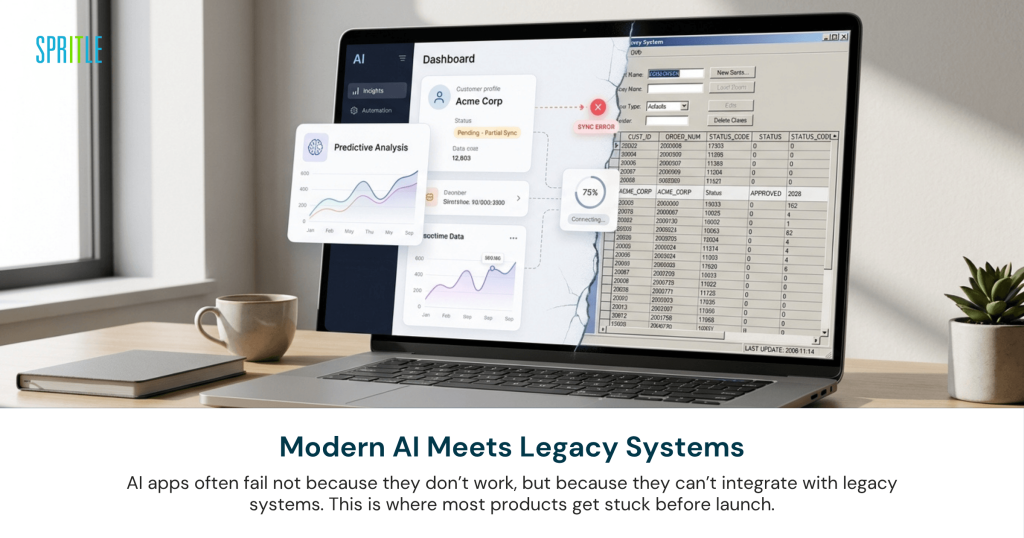
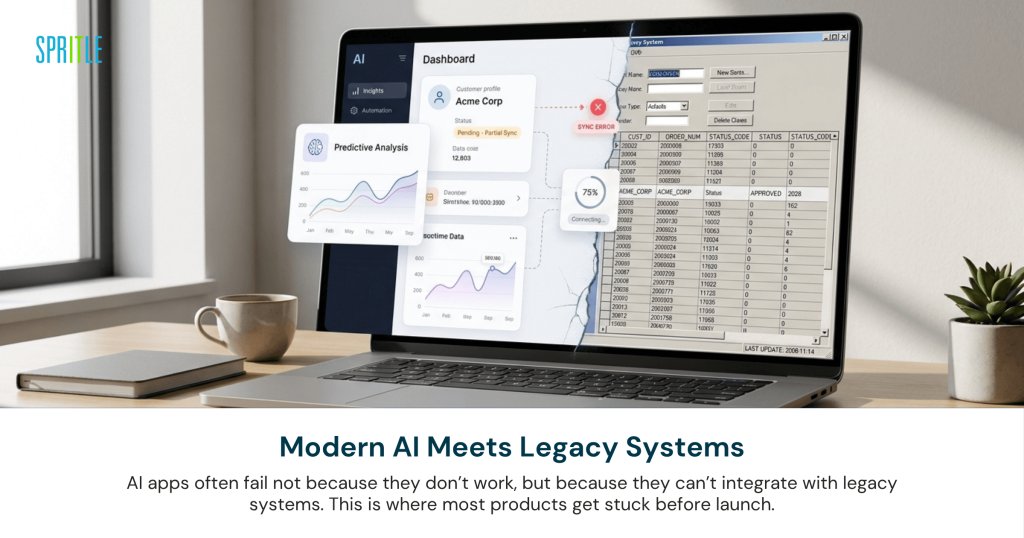
Why integrating AI applications into legacy systems is harder than it looks
On paper, it sounds simple: connect your new AI-powered frontend to your existing backend.
In fact, legacy systems are not built for this.
Many older systems rely on:
- Monolithic structures
- Limited or outdated APIs
- Custom business logic is buried in code
- Incompatible data structures
According to IBM’s 2023 report, more than 70% of enterprise applications still rely on legacy infrastructure. That’s a stark contrast to how modern AI app builder tools work.
AI developers produce clean, modern code. Legacy systems expect rigid, often unwritten formats.
That space is where things break.
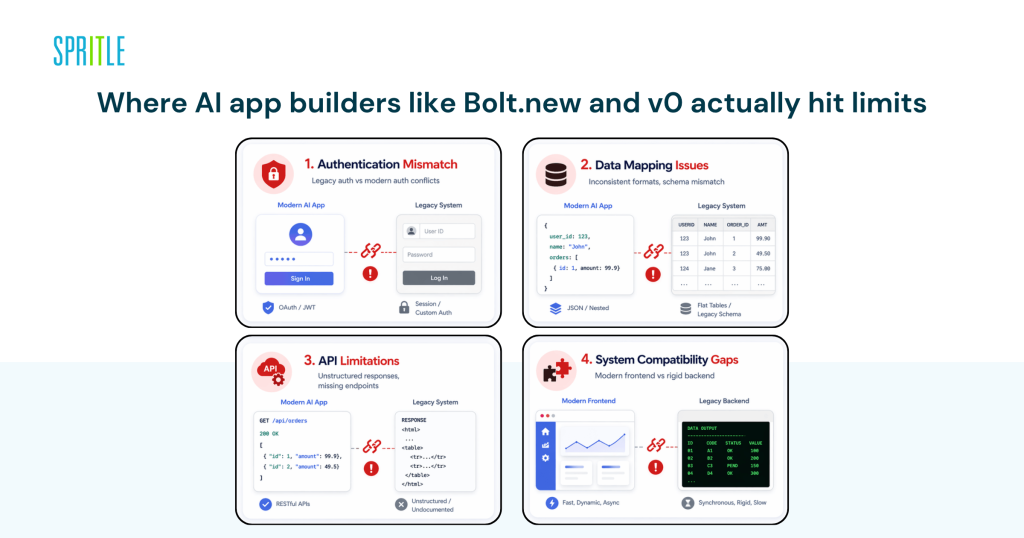
Where AI app developers like Bolt.new and v0 are actually reaching the limits
Tools like Bolt.new, Cursor AI, and Vercel’s v0 are amazing:
- Generates UI quickly
- It creates the basic backend logic
- Connects to standard APIs
- Spinning prototypes in hours
But here is the hard truth.
They struggle when things stop being “normal.”
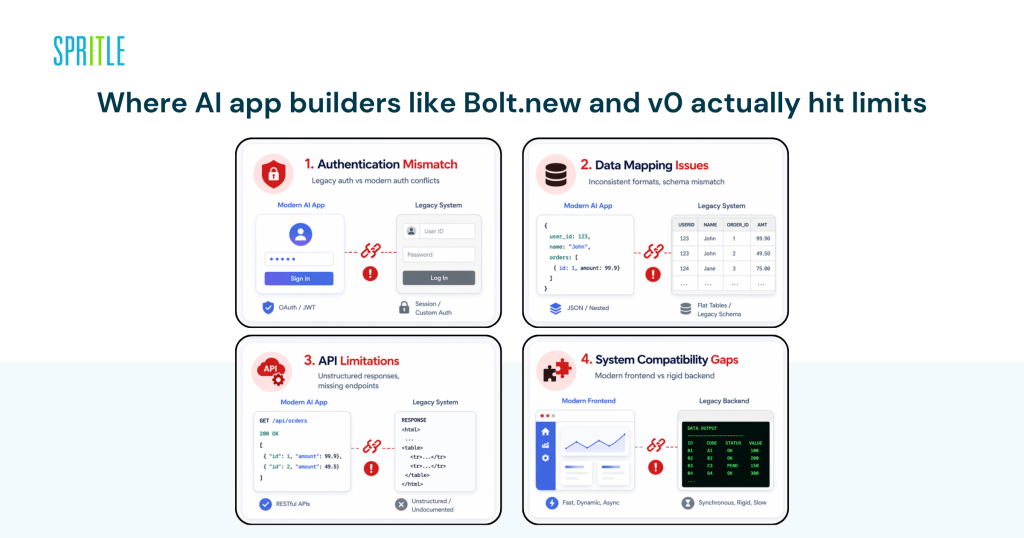
Custom authentication systems
Legacy systems often use:
- Session-based authentication
- Custom token logic
- Paragraph sections are not written anywhere
AI builders default to modern auth like OAuth or JWT. Closing those worlds requires manual intervention.
Data transformation and mapping
Your legacy database can store:
- Dates are in incompatible formats
- Objects placed on flat tables
- Business rules are implemented at the database level
AI tools do not fully understand this context. They create ideas. That assumption breaks down in productivity.
API incompatibility
Old APIs:
- Lack of proper documentation
- Return unexpected responses
- It requires chained calls or workarounds
AI-generated integrations fail here because they expect clean, RESTful behavior.
This is the part that AI developers won’t solve.
The real cost of staying stuck at 80%
Many founders underestimate what this delay is costing them.
It’s not just a technical problem. It is a business obstacle.
- Missed startup times → delayed revenue
- Poor integration → broken user experience
- Manual workarounds → more work
- Safety gaps → exposure to real risk
Gartner’s 2024 estimate suggests integration delays could push back product launches by 3–6 months on average.
That’s no small delay. That’s a lost market opportunity.
And here’s the thing: cutting your way out of it rarely works.
What does the elimination of technology look like in practice
This is where the transformation takes place. There are no other warnings. Real engineering.
When someone hires a service to complete an AI application, the focus shifts from building to stabilizing and scaling.
1. System assessment and gap mapping
We begin by identifying:
- What you have created is your AI application builder
- What your legacy system expects
- Where it is not the same
This step alone ends weeks of confusion.
2. Middleware and API orchestration
Instead of forcing direct communication, we:
- Build middleware layers
- Organize data formats
- Manage retries, errors, and edge cases
This makes both programs “speak the same language.”
3. Reorganization of the database (without violating existing ones)
We don’t rip everything.
We:
- Create adapters
- Introduce the schema map
- Add layers of authentication
So your AI applications can run without corrupting legacy data.
4. Readiness for production
This is where most AI-powered apps fail.
We handle:
- Distribution pipes
- Nature adjusts
- Strengthening security
- Performance tuning
Real world situations: where this is actually solved
Let’s make this concrete.
Scenario 1: SaaS developer using v0 with Vercel
Build a client dashboard using v0. It looks polished.
Problem:
It won’t sync with your legacy CRM built in PHP.
Fix:
We are building a middleware API layer that:
- Translates modern JSON requests into legacy formats
- It handles the authentication bridge
- Synchronizes data in two directions
Result:
Live dashboard, real-time updates, no CRM rewrite required.
Scenario 2: E-commerce owner uses Bolt.new
Build a storefront with AI.
Problem:
Payment integration works in test mode but fails in production due to custom tax logic in your background.
Fix:
We:
- Reconfigure the payment flow
- Combine the back tax rules
- Add validation and reverse capture
Result:
The transaction goes through reliably. Income is open.
Scenario 3: Agency prototype built with Cursor AI
Build a client MVP quickly.
Problem:
The application crashes under real user load due to inefficient queries and lost cache.
Fix:
We:
- Prepare database queries
- Introduce cache layers
- Set up a monitor
Result:
Stable app, ready to scale.
When you need more than an AI app builder
Here is a pattern we see over and over again.
The teams that post the fastest are not the ones that keep processing the information.
They are the ones who notice the border.
AI app builders are amazing:
- Speed
- Prototyping
- Early confirmation
But if you hit:
- Complex integration
- Legacy plans
- Production requirements
You need someone who understands both worlds.
That’s the gap that most people don’t plan for.
And that’s why “fix my website built for AI” and “hire a developer to complete an AI application” searches are growing rapidly in the US.
You can look to our technology partner for AI-powered apps
Not all developers are a good fit here.
You need someone who:
- It understands how AI application developers code
- Can debug unexpected output
- Experienced in legacy system integration
- Know when to redo versus patch
Here’s a quick checklist:
- Have they worked with tools like Replit AI or v0?
- Can they explain your architecture clearly?
- Do they prioritize stability over quick fixes?
- Can they handle shipping and handling?
Otherwise, you will end up rebuilding instead of finishing.
Frequently Asked Questions
Q: Can I fully integrate AI applications with legacy systems without rewriting everything?
A: Yes, in most cases. Using middleware and API layers, you can connect modern AI applications to legacy systems without a full redesign. The key is to map the correct data and host inconsistencies.
Q: Why do AI application developers fail with legacy integration?
A: AI application developers adopt modern, standardized APIs and data formats. Legacy systems often have custom logic, outdated architecture, and undocumented behavior that requires manual engineering.
Q: How do I know if I need an AI application completion service?
A: If your application works in some parts but breaks during integration, payments, authentication, or scaling, you may have reached the limit of what AI alone can handle.
Q: Is it faster to rebuild or modify an application built with AI?
A: In most cases, repairs and completions are quick and cost-effective. A systematic review can identify what can be salvaged and what needs to be reworked.
A Final Thought
You didn’t waste time building with AI. You’ve sped up the hardest part: getting the real thing into existence.
The gap you face now is not failure. It is a turning point.
AI apps give you a boost. Mergers and acquisitions take you to market.
What this really means is simple. You are closer than you think. You just need the right kind of help to cross the finish line.